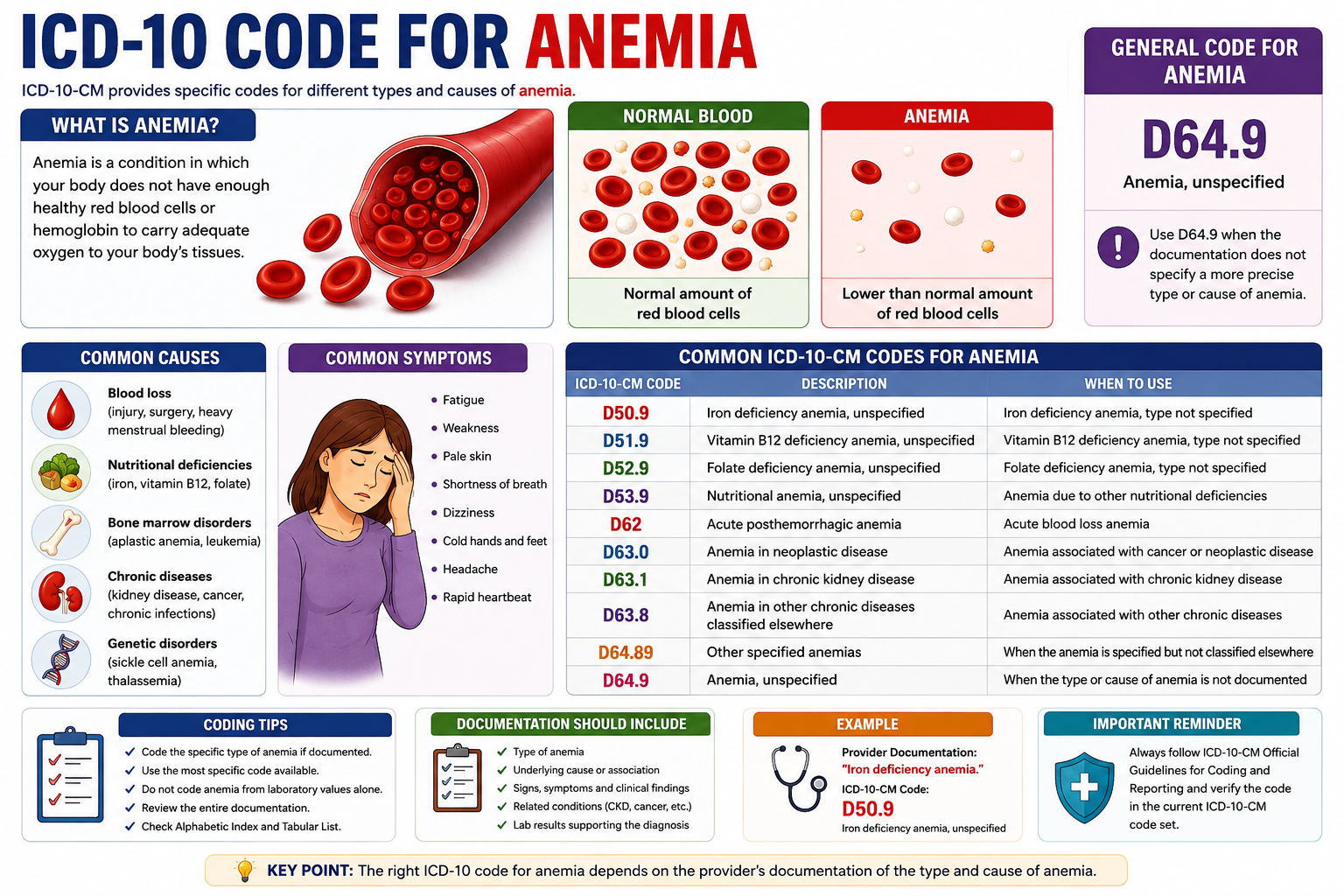
The ICD-10 code for anemia depends on the type, cause, and documentation of the condition. Anemia is a common diagnosis encountered in medical coding, and ICD-10-CM provides different codes for specific types of anemia.
The most commonly searched code is D64.9 – Anemia, unspecified. However, coders may encounter specific diagnoses such as iron deficiency anemia, acute blood loss anemia, vitamin B12 deficiency anemia, folate deficiency anemia, hemolytic anemia, aplastic anemia, anemia in chronic kidney disease, and anemia in neoplastic disease.
This guide explains common anemia ICD-10-CM codes, coding considerations, documentation requirements, examples, and frequently asked questions.
What Is Anemia?
Anemia is a condition in which the blood has a reduced ability to carry oxygen because of a decrease in red blood cells, hemoglobin, or both.
Anemia can have many causes, including:
- Iron deficiency
- Blood loss
- Vitamin B12 deficiency
- Folate deficiency
- Chronic kidney disease
- Chronic diseases
- Malignancy
- Hemolysis
- Bone marrow disorders
- Nutritional deficiencies
- Genetic conditions
For medical coders, identifying the specific type and cause of anemia documented by the provider is important when selecting the appropriate ICD-10-CM anemia code.
What Is the ICD-10 Code for Anemia?
The ICD-10-CM code for anemia, unspecified is:
D64.9 – Anemia, unspecified
D64.9 is used when the provider documents anemia but does not specify a more particular type or cause that is classified elsewhere.
However, coders should not automatically assign D64.9 whenever anemia is documented. If the medical record identifies a specific type of anemia, a more specific ICD-10-CM code may be appropriate.
Common ICD-10-CM Anemia Codes
| Anemia Diagnosis | ICD-10-CM Code |
|---|---|
| Iron deficiency anemia, unspecified | D50.9 |
| Vitamin B12 deficiency anemia, unspecified | D51.9 |
| Folate deficiency anemia, unspecified | D52.9 |
| Nutritional anemia, unspecified | D53.9 |
| Acute posthemorrhagic anemia | D62 |
| Anemia in neoplastic disease | D63.0 |
| Anemia in chronic kidney disease | D63.1 |
| Anemia in other chronic diseases classified elsewhere | D63.8 |
| Other specified anemias | D64.89 |
| Anemia, unspecified | D64.9 |
Always verify the final code using the applicable ICD-10-CM code set, Alphabetic Index, Tabular List, and Official Guidelines.
D64.9 – Anemia, Unspecified
D64.9 – Anemia, unspecified is one of the most commonly used and searched anemia ICD-10 codes.
This code may be appropriate when the provider documents anemia without identifying a specific type or underlying cause.
Example
Provider documentation:
“Patient has anemia. Continue to monitor CBC.”
If the provider does not document a more specific type of anemia, D64.9 – Anemia, unspecified may be appropriate.
D64.9 Coding Tip
Do not automatically use D64.9 when a specific type of anemia is documented.
For example:
Documentation: Iron deficiency anemia
The coder should review the D50.- category rather than automatically assigning D64.9.
Iron Deficiency Anemia ICD-10-CM
Iron deficiency anemia is classified under category D50.
One commonly used code is:
D50.9 – Iron deficiency anemia, unspecified
D50.9 may be appropriate when the provider documents iron deficiency anemia without further specificity.
Common searches related to this diagnosis include:
- Iron deficiency anemia ICD-10
- Iron deficiency anemia ICD-10-CM
- ICD-10 code for iron deficiency anemia
- D50.9
- Iron deficiency anemia code
The documentation should be reviewed to determine whether a more specific code applies.
Acute Blood Loss Anemia ICD-10
The ICD-10-CM code for acute posthemorrhagic anemia is:
D62 – Acute posthemorrhagic anemia
Acute blood loss anemia may occur after significant bleeding associated with surgery, trauma, gastrointestinal bleeding, childbirth, or another documented condition.
Coding Example
Documentation:
“Acute blood loss anemia following surgery.”
The coder should review the complete medical record to determine whether additional codes are required for the underlying source of bleeding or another associated condition.
Anemia in Chronic Kidney Disease ICD-10
The ICD-10-CM code for anemia associated with chronic kidney disease is:
D63.1 – Anemia in chronic kidney disease
When anemia is documented as being associated with CKD, the appropriate chronic kidney disease code should also be reviewed.
Coding Tip
Review the Tabular List for applicable sequencing and additional-code instructions.
The relationship between anemia and chronic kidney disease should be supported by the provider documentation and applicable coding guidelines.
Anemia in Neoplastic Disease ICD-10
The ICD-10-CM code for anemia in neoplastic disease is:
D63.0 – Anemia in neoplastic disease
When anemia is documented as being associated with a malignancy, the complete medical record should be reviewed.
The underlying neoplasm should also be evaluated for appropriate coding.
Anemia in Other Chronic Diseases
ICD-10-CM also includes:
D63.8 – Anemia in other chronic diseases classified elsewhere
This code may apply when anemia is associated with another chronic disease and the classification provides for this diagnosis.
The underlying disease should be identified and coded according to the applicable ICD-10-CM instructions.
Vitamin B12 Deficiency Anemia ICD-10
Vitamin B12 deficiency anemia is classified under category D51.
A commonly used code is:
D51.9 – Vitamin B12 deficiency anemia, unspecified
More specific documentation may support a more specific code within the D51 category.
Common related searches include:
- B12 deficiency anemia ICD-10
- Vitamin B12 deficiency anemia ICD-10
- D51.9
- ICD-10 code for B12 deficiency anemia
Folate Deficiency Anemia ICD-10
Folate deficiency anemia is classified under category D52.
A commonly used code is:
D52.9 – Folate deficiency anemia, unspecified
The provider documentation should be reviewed to determine whether a more specific diagnosis is available.
Nutritional Anemia ICD-10
Nutritional anemias are classified under category D53.
One commonly used code is:
D53.9 – Nutritional anemia, unspecified
The specific nutritional cause should be reviewed when documented.
Hemolytic Anemia ICD-10
Hemolytic anemia is classified in several ICD-10-CM categories depending on the documented cause.
Examples include:
- D58.9 – Hereditary hemolytic anemia, unspecified
- D59.9 – Acquired hemolytic anemia, unspecified
Other codes within categories D55-D59 may apply depending on the specific diagnosis.
The coder should verify the diagnosis using the ICD-10-CM Alphabetic Index and Tabular List.
Aplastic Anemia ICD-10
Aplastic anemia is classified under category D61.
One example is:
D61.9 – Aplastic anemia, unspecified
The appropriate code depends on the specific type and provider documentation.
Other Specified Anemias
When the provider documents a specified anemia that does not have a more specific classification, an applicable code may be found under:
D64.89 – Other specified anemias
The coder should verify the documented diagnosis before assigning an “other specified” code.
ICD-10 Anemia Code Categories
D50 – Iron Deficiency Anemia
Category D50 includes different types of iron deficiency anemia.
D51 – Vitamin B12 Deficiency Anemia
Category D51 includes anemia associated with vitamin B12 deficiency.
D52 – Folate Deficiency Anemia
Category D52 includes folate deficiency anemia.
D53 – Other Nutritional Anemias
Category D53 includes certain nutritional anemias not classified elsewhere.
D55-D59 – Hemolytic Anemias
These categories include different hereditary and acquired hemolytic anemias.
D60-D61 – Aplastic and Related Anemias
These categories include acquired pure red cell aplasia and aplastic anemia.
D62 – Acute Posthemorrhagic Anemia
D62 represents acute posthemorrhagic anemia.
D63 – Anemia in Chronic Diseases Classified Elsewhere
This category includes anemia associated with neoplastic disease, chronic kidney disease, and certain other chronic diseases.
D64 – Other Anemias
Category D64 includes other specified anemias and D64.9 – Anemia, unspecified.
How to Choose the Correct ICD-10 Code for Anemia
Choosing the correct ICD-10 anemia code requires reviewing the complete medical record.
1. Review Provider Documentation
Look for the exact diagnosis documented by the provider.
Examples include:
- Anemia
- Iron deficiency anemia
- Acute blood loss anemia
- Anemia due to CKD
- Anemia in neoplastic disease
- Vitamin B12 deficiency anemia
- Folate deficiency anemia
- Hemolytic anemia
- Aplastic anemia
2. Identify the Type of Anemia
Determine whether the provider has documented a specific type of anemia.
A specific diagnosis may lead to a more specific ICD-10-CM code.
3. Identify the Underlying Cause
Determine whether the anemia is associated with another documented condition.
Examples include:
- Chronic kidney disease
- Malignancy
- Acute blood loss
- Nutritional deficiency
- Chronic disease
4. Check the Alphabetic Index
Locate the documented diagnosis in the ICD-10-CM Alphabetic Index.
5. Verify the Tabular List
Always verify the selected code in the Tabular List.
Review:
- Inclusion terms
- Excludes notes
- Code first instructions
- Use additional code instructions
- Other applicable notes
6. Apply the Official Coding Guidelines
Review the applicable ICD-10-CM Official Guidelines for Coding and Reporting before finalizing the code.
Can Low Hemoglobin Be Coded as Anemia?
A low hemoglobin result does not automatically mean that the coder should assign an anemia diagnosis.
For example:
Laboratory result: Hemoglobin 8.5 g/dL
The laboratory result alone should not automatically be converted into an anemia diagnosis.
The coder should review the provider’s documentation and applicable coding requirements.
If the provider documents “anemia,” the coder can evaluate the appropriate ICD-10-CM code based on the documented diagnosis.
Is D64.9 Used for Every Type of Anemia?
No.
D64.9 specifically represents anemia, unspecified.
When the provider documents a specific type of anemia, the coder should review the appropriate classification.
Examples include:
- Iron deficiency anemia → D50.-
- Acute posthemorrhagic anemia → D62
- Anemia in neoplastic disease → D63.0
- Anemia in chronic kidney disease → D63.1
- Anemia in other chronic diseases → D63.8
Anemia Coding Examples
Example 1: Unspecified Anemia
Documentation:
“Patient has anemia.”
Possible ICD-10-CM code:
D64.9 – Anemia, unspecified
Example 2: Iron Deficiency Anemia
Documentation:
“Iron deficiency anemia.”
Possible ICD-10-CM code:
D50.9 – Iron deficiency anemia, unspecified
Example 3: Acute Blood Loss Anemia
Documentation:
“Acute posthemorrhagic anemia following acute blood loss.”
ICD-10-CM code:
D62 – Acute posthemorrhagic anemia
Example 4: Anemia in CKD
Documentation:
“Anemia associated with chronic kidney disease.”
ICD-10-CM code:
D63.1 – Anemia in chronic kidney disease
Review the record for the appropriate CKD code as well.
Example 5: Anemia in Malignancy
Documentation:
“Anemia in neoplastic disease.”
ICD-10-CM code:
D63.0 – Anemia in neoplastic disease
The underlying neoplasm should also be reviewed.
Common Anemia Coding Mistakes
Using D64.9 for a Specific Anemia
If the provider documents iron deficiency anemia, do not automatically assign unspecified anemia.
Coding Only From Laboratory Results
Do not automatically convert a low hemoglobin or hematocrit result into an anemia diagnosis.
Not Reviewing the Tabular List
Finding a code in the Alphabetic Index is not the end of the coding process.
Missing the Underlying Condition
Some anemia codes are associated with another disease and may require additional coding.
Ignoring Sequencing Instructions
Always review code first, use additional code, and other applicable instructions.
Anemia ICD-10-CM Coding Tips for Medical Coders
- Start with the provider’s documented diagnosis.
- Identify the specific type of anemia.
- Determine whether an underlying condition is documented.
- Do not code solely from laboratory values when provider documentation is required.
- Check the Alphabetic Index.
- Verify the code in the Tabular List.
- Review Excludes notes.
- Review sequencing instructions.
- Check whether an additional code is required.
- Use the appropriate ICD-10-CM code set for the applicable year.
- Do not assume that every anemia should be coded D64.9.
Frequently Asked Questions About Anemia ICD-10
What is the ICD-10 code for anemia?
The ICD-10-CM code for anemia, unspecified is D64.9.
What is D64.9?
D64.9 is Anemia, unspecified.
What is the ICD-10 code for iron deficiency anemia?
D50.9 is Iron deficiency anemia, unspecified, when the documentation does not provide greater specificity.
What is the ICD-10 code for acute blood loss anemia?
The code is D62 – Acute posthemorrhagic anemia.
What is the ICD-10 code for anemia in CKD?
The code is D63.1 – Anemia in chronic kidney disease.
What is the ICD-10 code for anemia in neoplastic disease?
The code is D63.0 – Anemia in neoplastic disease.
What is the ICD-10 code for B12 deficiency anemia?
A commonly used unspecified code is D51.9 – Vitamin B12 deficiency anemia, unspecified.
What is the ICD-10 code for folate deficiency anemia?
A commonly used unspecified code is D52.9 – Folate deficiency anemia, unspecified.
Is D64.9 a billable ICD-10-CM code?
Yes. D64.9 is a billable ICD-10-CM code for anemia, unspecified for the applicable code year.
Can low hemoglobin be coded as anemia?
Not automatically. Review the provider documentation and applicable coding guidelines.
What is the difference between D64.9 and D50.9?
D64.9 represents anemia, unspecified, while D50.9 represents iron deficiency anemia, unspecified.
Final Takeaway
The ICD-10 code for anemia depends on the documented type and cause of the condition.
For unspecified anemia, the code is:
D64.9 – Anemia, unspecified
Other commonly encountered anemia ICD-10-CM codes include:
- D50.9 – Iron deficiency anemia, unspecified
- D62 – Acute posthemorrhagic anemia
- D63.0 – Anemia in neoplastic disease
- D63.1 – Anemia in chronic kidney disease
- D63.8 – Anemia in other chronic diseases classified elsewhere
- D64.89 – Other specified anemias
For accurate medical coding, always review the provider documentation, ICD-10-CM Alphabetic Index, Tabular List, applicable coding instructions, and current Official Guidelines before assigning the final code.